
Building Restoration
- Home
- :
- Building Restoration
Contact Details:
- (+91) 970-244-3244
- infrasquadheritage@gmail.com
- Office No.02, Galaxy Avenue, 88, Sector No. 22, Phase II, Sector 22, Kamothe, Panvel, Navi Mumbai, Maharashtra 410209
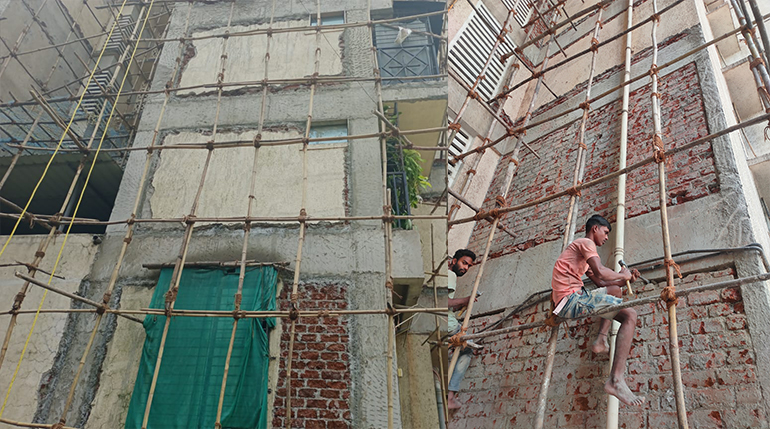
Building Restoration
Building repairing and painting work thoroughly survey examines the building’s structure, foundation, plumbing systems, and other critical components. This evaluation is necessary to identify any issues that may require restoration, such as cracks, leaks, or damage to the building’s facade or roof. Building restoration services follow a systematic process that involves several basic stages to ensure the successful restoration of the building. The process includes the following:
- Stage 1: Erecting Bamboo Scaffolding.
Providing erecting single bamboo scaffolding around the building for the full height at a time and removal of the same after completion of work. The scaffolding is to be secured properly in position providing and erecting working platform, Debris Coalition platform at any height required using material like wooden plank with proper support etc. Secured in position.
- Stage 2: Civil Work.
- Breaking of Plaster / Concrete
- Remove break, existing damage, loose plaster and concrete from brickwork and RCC members. That is column, beam, lintels, slab, sajja, fins, pardi, dead walls, etc. Up to the sound concrete by lightweight hammer or chisel or lightweight concrete breaker and the debris shall be taken down and stacked or carted away as directed
- Structural repairs.
- Rust remover - Providing and applying a coat of rust remover of approved make to the rusted steel and removing the rust by steel brush of good quality after application of rust remover as per manufacturers specification.
- Additional reinforcement - Providing & welding reinforced bar of approved make & required dia, if existing reinforcement size has reduced to half of dia or as per site condition up to any depth. Weight of reinforced bar will be paid in Kg basis separately.
- Passivator coat - Providing and applying approved make passivator code to expose rebars and also new rebars completely.
- Bond Coat - Providing and applying one coat of polymer cement bonding coat (PCBC) of approved manufacturers, duly mixed with cement in ratio by weight over the exposed concrete surfaces as per manufacturers' specification.
- Polymer Modified Mortar - Providing & applying after the bond coat has become tacky/sticky in layers polymer modified cement based ready mix mortar up to 20 mm thick (Avg) in uniform layers, of approved make prepared by mixing water content as per manufacturer specification, in layers not more than 20 mm thick, finish the surface with steel trowel or roughen the surface for receiving further treatment, curing the surface as per manufactures specifications.
- Micro Concrete - Providing encasement to columns/beams/pardi etc., with free flow high strength non shrink micro self-compacting concrete M - 40 Or Higher Grade using single cement micro concrete shrinkage components added with 100% by weight saturated dry stone dust. The water cement ratio should be maintained as per manufacturer's specifications to achieve dense solid mass. The Micro concrete shall be poured properly in slurry tight prefixed holding boards formwork, fixed properly in line, level and in the required size/shape and well-oiled etc. The air bubbles, if any shall be removed by tapping the boards and removing the same after 24 hours, curing the micro-concrete thoroughly for 14 Days etc.
- Separation Joint Filling between RCC and wall - Raking out the joints between RCC and wall to a clear width of 20-25 mm, cleaning the same thoroughly with running water at all heights & locations. Applying an approved polymer bond coat followed with filling the gap with 1:3 cement mortar impregnating with 10mm to 20 mm downgraded metal pieces, curing etc.
- Plaster Work.
- The first coat is mortar in cement: sand 1:4 proportions, with a water cement ratio not exceeding 0.45. Sand face cement plaster of average 20 MM thick in two coats at all heights with first coat to be of approx. 12 MM thick of plaster including using an approved waterproofing compound Approx. 1 KG to 1 bag of cement to prevent shrinkage cracks as per manufacturer specifications complete. The surface shall be even and without any undulations so as to have a thin second coat. The first coat is made rough to provide a key to the second coat. The base plaster shall be thoroughly watered and cured for minimum two days before the second coat is applied. If second coat is not to be done immediately, then minimum seven days curing must be done.
- The second coat shall be a thin layer of mortar with cement: sand 1:5, using, fine washed sand and the approved additive, applied evenly by a trowel and finished to required granular texture by a rubber sponge & gudgudi. Roughening the first coat to receiving the second coat approx. 8 MM thick of plaster including using an approved waterproofing compound Approx. 1 KG to 1 bag of cement to prevent shrinkage cracks as per manufacturer specifications complete. The final line, level and plane shall match the existing unbroken plaster. The second coat shall be kept wet by watering and shall not be allowed to dry for at least seven days.
- Stage 3: Building Surface Preparation.
- MS item’s scraping & Priming - Providing and scraping window MS grill, Railing, Gate, ladder, doors rub off all the rust. After removing the rust, apply Zinc Yellow Metal Primer on it.
- Jet Wash Cleaning & Crack Filling - After completion of structural repair and plaster work on the outside of the building as well as in the balcony and parking area, after grill scraping and treating the surface cracks by making a ‘V’ groove of required depth and width, the entire building will be properly washed with a jet wash machine high-pressure water spray to remove loose paint, mold, fungal, grime, dust, mud, and dirt from wall surfaces, after which all the cracks made by crack cutting will be filled with chemical crack filler proper finish as per manufacturer specifications complete.
- Stage 4: Building Painting.
- External Wall Painting - Providing and applying one coat of water based acrylic anti-fungal Primer of approved quality and make as per sample approved. Providing and applying one coat of fibre reinforced membrane paint water proofing Coat of "Protek Basecoat" of Asian/ "Weather coat Roof Guard" of Berger / "Aqua Tech" of ICI or equivalent approved by the Client having crack bridging ability up to 2.00 mm, superior anticarbonation & water proofing property. Providing and applying 2 or more coats of approved quality External Acrylic Emulsion paint, Exterior grade having anti-fungal property, resistance to dust & dirt accumulation, resistance to fading of colours etc. of approved colour and shade as per manufacturer specifications complete.
- Internal Painting - Preparing the earlier treated surface by scraping rubbing with sand paper applying two coats of Birla white putty including its rubbing with sand paper to ensure smooth surface including applying one coat of approved make primer and 2 or more coats of approved colour and shade of Acrylic Distemper/Plastic Paint to internal walls/ceiling of the Lobby areas, Staircase, common areas etc. including necessary scaffolding etc. complete.
- Oil Paint - Preparing the surface by scraping rubbing with sand paper to ensure smooth surface including applying one coat of primer and 2 or more coats of approved colour and shade of Synthetic Enamel Paint to doors / window frames and shutters, MS Railing / Grills, MS Gate’s etc.
- 100 % Acrylic Paint - Applying one coat of approved make primer and 2 or more coats of approved colour and shade of Acrylic Paint to Plumbing Duct, Closed Balcony, Parking Area, Compound Wall etc. including necessary scaffolding etc. complete.